Charity Therapy Podcast
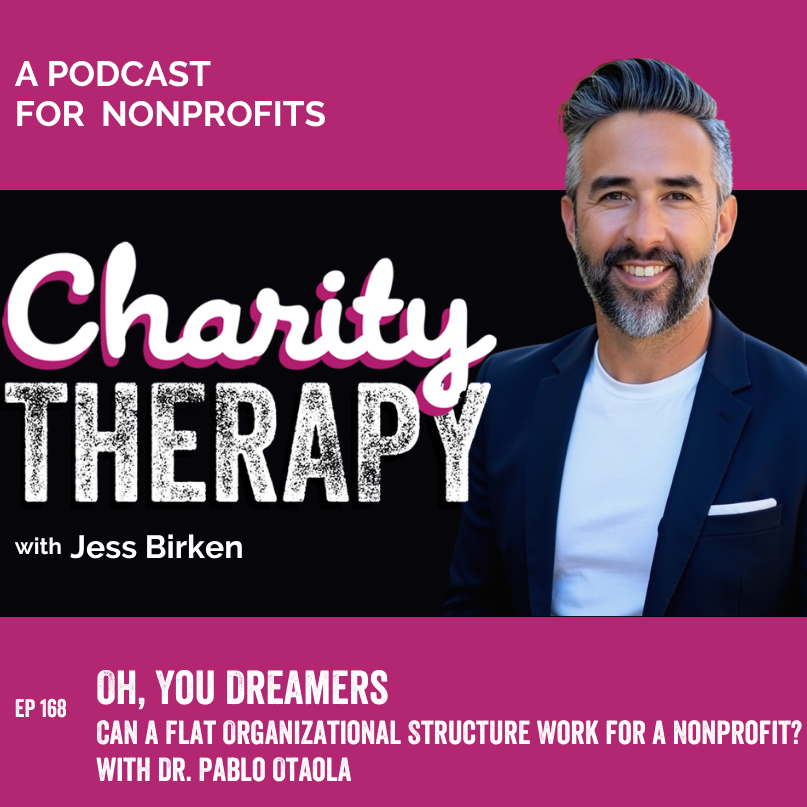
168: Oh, You Dreamers | Can a Flat Organizational Structure Work for a Nonprofit? with Dr. Pablo Otaola
A nonprofit was built to run like a co-op. Everyone's equal. There's no HR. Is that your dream, or a nightmare that feel suspiciously like high school?
I'm joined by Dr. Pablo Otaola, CEO of Thriving Culture LLC, to tackle a listener question about this exact scenario. An executive director walked into an organization built on flat structure ideals, but instead of a utopia they found bullying, cliques, and power plays..
Real Listener Question:
"I'm an ED for a nonprofit with a flat structure. We supposed to run like a co-op, where everyone but the board and ED shares the same title. The goal was to create a fair and equitable environment, but in practice it's like high school. Bullying, power plays, cliques trying to control the group with zero accountability. How do I change the organization?"
Pablo and I break down the problems we've seen with flat organizational structures, what actually creates a thriving culture, and how a nonprofit leader can start changing the DNA of an org that's been stuck for years.
What You'll Learn:
- The building blocks of a healthy organizational culture
- Why flat structures look SO good on paper but may fall flat (pun intended!) in real life
- Why "no HR" is a legal red flag no matter how good your intentions are
- How a leader's personality can get embedded into org culture
- What it really takes to change a culture that's been encoded for years
- When to stop reading blogs and get outside help from someone who's done this before
Bottom line: You don't hire the surgeon not to cut you. If your culture is broken, it's okay to ask for help. Change is uncomfortable, but it's the only way forward!
Resources from this Episode
- Learn more about Pablo's work at Thriving Culture LLC: https://www.thrivingculturellc.com/
- Previous Episode: https://birkenlaw.com/charity-therapy-podcast/ct167-directors-officers-insurance-cody-wiswasser/
- Episode Transcript: https://birkenlaw.com/wp-content/uploads/2026/07/CT168_Transcript.pdf
Connect with Us
- Jess Birken: https://www.linkedin.com/in/jessbirken/
- Dr. Pablo Otaola: https://www.linkedin.com/in/pablootaola/
Listen & Engage
- Listen on Apple Podcasts | Spotify | YouTube | Amazon Music
- Rate & Review on Apple Podcasts: Click "Ratings and Reviews" then "Write a Review"
- Send us your nonprofit questions: https://birkenlaw.com/podcast/#podcast-story
Stay Connected
- Sign up for the Birken Law Email list: https://birkenlaw.com/signup/
- Follow us on Facebook, Instagram, Twitter
Transcript
Jess Birken 00:00:02 Welcome to Charity therapy, the podcast where we explore the ups and downs of the nonprofit sector and answer your burning questions. I'm your host, Jess Birken, owner of Birken Law Office, and I'm excited you're here. Imagine hanging out with me and my super smart, funny, nonprofit expert pals. You get to ask them anything about your nitty gritty nonprofit life and get their wisdom for free. Whether you're a seasoned pro or just strapping on your nonprofit boots, we're here to share stories and remind you you're not alone on this journey. So get ready to join the conversation and bring me the tough questions I ain't scared. Ready to rock? Let's dive in. Hello and welcome to this episode of Charity therapy. Today I am joined by Doctor Pablo Otaola. Pablo is the CEO of Thriving Culture LLC, and he's who CEOs can call when there's something broken in their org that needs to be fixed or needs to be fixed. Yesterday. Pablo. Thanks for coming on the pod, swooping in, bringing your toolbox to help us work through some things.
Pablo Otaola 00:01:10 Yeah, absolutely. Thank you for the invite. I'm excited about this.
Jess Birken 00:01:13 Heck, yeah. I mean, when you and I first met, I feel like I was just, like, in love with you immediately. Like, I was just like, oh, my gosh, I love Doctor Pablo. He's amazing. And I could not wait to have you on the podcast, especially because I feel like I nerd it out a little bit about how much I loved my organizational theory and development classes and my master's degree. And just like, that's your vibe. Like, you're all about like, organizational culture. And when people talk about culture, quote unquote, in the nonprofit sector, usually I'm hearing it because something's going wrong, right? More often than not, people only bring it up if it's not happening. Well, but I love the name of your company that we're trying to build a thriving culture. And it's not just about preventing toxic culture, it's building something strong. Right? So to you, like what really are the hallmarks of a strong, healthy organizational culture?
Pablo Otaola 00:02:19 Yeah.
Pablo Otaola 00:02:19 So first of all, let me respond. I nerd it out with you as well. And I, I felt the same thing and I was like, where can I talk to them again? And.
Jess Birken 00:02:30 Right.
Pablo Otaola 00:02:31 Super excited. Super excited. I think we have a similar vibe, similar lane, maybe same house, different window as far as perspectives, yes. What we do, but in the nonprofit sector, yes. Same. We're there. And yeah, I mean thriving culture. The name came about because I was in a non thriving culture and no one wanted to get out of it. Went and got a doctorate. And and I just really want to partner with nonprofits and I mean for benefit mission oriented organizations that are that are down, that want to do that, that want to create a place they want to go work in, you know.
Jess Birken 00:03:13 Yeah.
Pablo Otaola 00:03:13 So hallmarks I mean, I think the I think the word belonging is probably at the center. And it doesn't mean like like, you know, Maslow's hierarchy needs it's right in the middle, the longing sense of belonging.
Pablo Otaola 00:03:25 It's not family. It's not my partner. It's not my son. So we're not talking about that. But. But we are talking about something tribal, something that that where we feel connected to people. And even as we go up in Maslow's hierarchy of needs, like respect. Like, I have pride in my work and at least within the career sector, within the organization, like you have that self-actualization where you feel like, dang, I'm being developed into somewhere, into someone that like, is better than who I am today. there's a vision for me. I want to be here. I trust people I could, like, call people into a better selves. And they're going to welcome me like it's. I can make mistakes and not feel punished by it.
Jess Birken 00:04:09 Yes. Yeah.
Pablo Otaola 00:04:10 Learning thing. Right. It's like failure is not failure. It's a learning opportunity. So if all of those dynamics are there, we can break it down into all the KPIs and all the other things. But really I look at it through Maslow's hierarchy of needs.
Pablo Otaola 00:04:24 And if if it has that middle, second and top tiers and you can use some of that language, I think you have a lot of the elements of a thriving culture.
Jess Birken 00:04:34 Okay. I love that you use the word belonging because for whatever reason, this job I had right after law school popped into my brain like just the other day, like in the last three days, for whatever reason, I was thinking about that work environment. And the second you said a healthy culture is. Includes. Belonging. I was like, oh yes, that is what was lacking in that job was I never felt like I really belonged there. It it always felt like I was sort of like on the outside. And it really made it that I was not thriving there at all. And so it was a very short position because it was like, I don't really feel like I belong here. So I'm moving on almost immediately. Right. That's incredible that, I mean, okay, so I graduated in 2007. That's 20 years ago.
Jess Birken 00:05:31 Basically. I'm still thinking about that apparently. Yeah, yeah. But that's how important that element is, is it's like that's incredible I love that okay. So bringing that are you ready to get into this listener question, this scenario that we've been served up.
Pablo Otaola 00:05:48 Let's do it. Let's do.
Jess Birken 00:05:50 It. Here we go. Listener writes hi there. I'm an executive director for a nonprofit with a unique structure. The organization was founded 12 years ago with the intention for it to run almost like a co-op, a cooperative. We have a board and the Ed role, but literally everyone else has the same job title. There is no HR. The goal is to create a strong, fair and equitable work environment. I've now been with the organization for three years, and it's becoming more and more clear that we are definitely not meeting that goal. I was excited to come into this structure, but in practice, everything seems to operate like it's high school. There's bullying, there's power plays and cliques that try to control the larger group without any accountability.
Jess Birken 00:06:40 I've been trying to attract good people into the organization, but it seems like no matter how many great people I bring in, the cycle repeats. How do I go about changing the organization? Wow. Okay. Lot to unpack there.
Pablo Otaola 00:06:55 Yeah. My my thoughts first. Your thoughts first. How do you want to start?
Jess Birken 00:06:59 Yeah. I think well, I definitely want to hear from you because that's why you're here. For sure. I want to kind of start off, I think with the flat structure and I'm really curious, have you actually seen these flat structures work? Because I have, over the years, had clients who are very committed to doing this, sort of like everybody's on the same plane or all equals structure. And I'm curious in your experience, if, if you feel like that really is the idyllic whoa, I don't know what the word for it is.
Pablo Otaola 00:07:35 Yeah. Well, I, I have never seen it work just to answer directly. I like the intent though, right? Like, yeah, I think a lot of times we experience organizations where it's just a mess.
Pablo Otaola 00:07:46 It's like one person that is managed by one person that is managed by one person that reports to three people, right. And you have like seven levels and you just need 2 or 3. Right. And that those scenarios. So. So there's some, some of that like the intent. There's also like the generational piece for me that like the older Gen X and an older just really value order and structure. And there's so much of it. There's too much bureaucracy, too much power play, too much like gender issues like that come from older generational values. And so what I definitely seen millennials, older millennials like start to do is try to like swing the pendulum back and go a lot more to these flat structures. But they usually don't work or they don't work. When we don't take into account personality, they don't take into account subconscious bias. We don't take into account social power dynamics. Longevity is a power deal, right? So you could have the same title, but it's not the same power just because on an org chart it looks on the same page.
Pablo Otaola 00:08:56 So I've never seen it work for those reasons. And while I like the intent you need, you need something kind of in the middle where there's some structure. Power is stewarded well and leaders themselves are hot, have high culture intelligence, understand some of the things that we just said. And because, I mean, you could have the best org structure. You have a leader and yep, you know it's great, right?
Jess Birken 00:09:21 So yeah. Or even somebody just in the middle who's, you know, kind of just stirring it up. You can have nice leaders and somebody flying under the radar just poisoning the well, so to speak, you know.
Pablo Otaola 00:09:34 Yeah.
Jess Birken 00:09:35 Yeah, yeah. Well that's that's like a relief to me because sometimes in my work, you know, like people, sometimes people come to me for like, really fun, uplifting, like, we're going to make something happen. Those are like my startup clients. I love that, but like, a lot of times, being a lawyer, you're coming in because there's a big mess, right? And so it's sometimes it's hard not to get like a little bit cynical about, you know, the sector and everybody, everybody, you know from the outside it looks like, oh, we're all holding hands singing Kumbaya and like everything's magical.
Jess Birken 00:10:08 But like, you and I know because we're in the trenches with the people.
Pablo Otaola 00:10:13 One.
Jess Birken 00:10:13 Seeing the the dirt under the carpet. Right. And so it's, it's almost like a relief that it's not just me thinking like, oh, you dreamers like, this is not going to work, because I also haven't seen it work.
Pablo Otaola 00:10:29 Yeah. There you go. I think I think it's good again. It's a good intent. And after you see it break in different ways over time, you just realized, oh, I do need some structure. You know, it doesn't need to be overboard.
Jess Birken 00:10:41 And I think people do crave structure. I mean, you know, you were talking about Maslow's hierarchy of needs, and this is not a scientific, but I always go to the like. Anthony Robbins like Ted, talk about the six human needs and like the certainty, the need for surprise, the need for significance. And just you can't meet all of the human needs with a totally flat organization because some people really need to experience feeling significant.
Jess Birken 00:11:12 Some people really need to feel certainty. They know what the structure is, right? It's like it just I don't think it works for humans. I think it works on paper. But humans are human beings are messy and complicated, and they're not all the same. Even if we look similar and share culture, we're still there's internal things happening that are different. There's just it doesn't work, you know?
Pablo Otaola 00:11:38 Yes. 100%. And and what you just said reminded me of the whole world of neurodiversity. You know, just like ADHD alone. The concreteness need and my partner ADHD. My mom, my two sisters, my son. Okay, so like I know this world totally still learning. But yeah, like no boundaries or a flat structure can mean no boundaries can mean freak out, you know, like, yes, where am I? Everything's everywhere. I just need some help. You know, these are highly, highly intelligent, gifted people that just need more than a flat structure. So the neurodiversity thing, man, that.
Jess Birken 00:12:17 Yeah, 100%. I've got a kid on the autism spectrum, and I'm like, this will not work. Like, we need a routine. We need to know what the rules are like 100%, 100%. Can we just for one second, there's no HR. There's a line in this question and I'm I, I'm like, y'all, what are you doing? What are you doing? Like, just as a sidebar, as the lawyer in me, my spidey sense, my little alert thing went off when I read that like. Oh my gosh. Like, you still have to follow employment law. Yeah. Just because you have a flat organization doesn't mean that you're not following. Employment law. And the biggest source of legal complications and legal expense is always going to be people problems. So I would absolutely encourage this listener to advocate for some kind of HR.
Pablo Otaola 00:13:13 Yeah.
Jess Birken 00:13:13 Saying, well, I just I just realized as I was saying, to advocate for HR, how how are we going to answer this question, Pablo? How do I go about changing the organization, being the executive director there for three years? We're 12 years in.
Jess Birken 00:13:32 Can one person really instigate this level of change?
Pablo Otaola 00:13:37 100%, yeah. But being so, I'll do some assumptions and some one plus one equals seven kind of math. Yeah. But okay, so if this Ed was okay with this dysfunction for three years, they probably have some level of responsibility in allowing it to happen for that long. Right. So that's that's a mentality that I have. And the framework that I use is that after especially after three years, but whoever the the leader is the CEO, president, you know, whoever write team lead, whoever they are, their anxiety, their depression, their neurodiversity gets embedded into the DNA of those they lead and therefore into the culture and the air that people read. So I'll just give a concrete example. I have anxiety and I take meds, and if I'm off my meds then that comes out at during stressful times.
Jess Birken 00:14:34 Absolutely.
Pablo Otaola 00:14:36 It means that I'm going to be more snippy and I'm going to make less wise decisions. And if that happens to be when we lose a client or something like that, or, or back in the nonprofit days like Q4, when I'm trying to close out the years, I mean, the year, you know, like bad decision after bad.
Pablo Otaola 00:14:54 Eventually people are going to start being like, hey, don't talk to him or don't say the wrong thing. And then the truth isn't sad and then we don't have the right data. So, so, you know, like my anxiety gets embedded into the process that of those that I lead. So that's the first thing that I would say is like, okay, let's sit down with the Ed and say or the Ed sit down on your own and just kind of own, like, what do I have to own in enabling this? And then usually it just takes a little outside collaboration, accountability, you know, to like, can you keep me accountable to doing the hard thing? Because usually, especially in the nonprofit field, that people just don't, like, hurt people's feelings. So that's kind of how we interpret, like, you know, some boundaries and some structures. Yeah. You know, so they're going to need to talk to someone, maybe on the board, maybe in an advisory board, maybe a consultant, that they can.
Pablo Otaola 00:15:50 I mean, shoot their therapist, you know? I don't know, 100%. They're going to have to change behavior because what when they change behavior, others will follow suit. And if others don't follow suit, then they're outside of what they should be doing. Too bad they don't have HR. But but that's probably what actually, you know, just thinking out loud here. Maybe that's the first thing they do is just get their number two and number three people and say, hey, we have a problem. Yes, yes, yes. All right. We need to hire at least a fractional HR person at first and have that person, you know, some change management, you know, the the strategy side of HR at the higher level and help us right. The the chip here because culture is made by leadership behavior. Three things leadership behavior structure and process. So they're going to have to look at all those three starting with leadership behavior, then the structure and then the process in that order. But they're going to need some help.
Jess Birken 00:16:47 Okay. So I'm glad that it was you that brought this up and not me, because usually I'm the one who's like, you guys got to be responsible. Yeah, any any time you're the manager and things are not going well. It should be a cue in my mind. It should be a cue to look in the mirror and say, hey, things are not going well with my direct reports. This is a me problem. And how can I fix the me problem? And once and only when you've, like, really exhausted that. Do I move on to like. Well, I guess it's you. Yes. Here's the thing I we don't have the information, but I almost wonder if this ed is a first time. Ed?
Pablo Otaola 00:17:27 Oh, yeah.
Jess Birken 00:17:28 I wonder if there is some other dynamic happening that we don't know about. We don't have insight into. Maybe there was like a charismatic founder who left and this new Eddie is supposed to be like the person who fixes everything or just fills these shoes.
Jess Birken 00:17:47 Or because, like, why are we not already leaning on the board? Right. There's some there's some.
Pablo Otaola 00:17:52 Disconnect.
Jess Birken 00:17:53 There.
Pablo Otaola 00:17:54 Yeah.
Jess Birken 00:17:54 And so it's like, it's not that, you know, I'm not hearing I talk to the board because I would expect the Ed is talking to the board about this. So if we're not hearing that that makes me kind of think, oh is this like your first time? Did we maybe come into a situation where it doesn't feel safe to talk to the board, maybe the board, like lionize the previous founder or there's some. Yeah, it feels like there's something going on there that this ed kind of feels like they're out on an island and isn't like, how is it this much out of their sort of purview that it's like, if it's like high school? Why? Why aren't you the principal?
Jess Birken 00:18:37 Right, right. You know.
Jess Birken 00:18:39 So.
Jess Birken 00:18:39 Right.
Jess Birken 00:18:40 I want to have compassion for this person. But we we don't like no more. So I'm like, I think there's something going on here.
Jess Birken 00:18:46 Maybe it's lack of experience, maybe there's some other weird dynamic that's happening. But I love the idea that the Ed would get some kind of coaching or even work with someone like you to sort of try, because culture is so hard to steer if everybody's not on the same page. Right? So like maybe is am I crazy? Like, is there a reality where an Ed sort of, like, works with someone like you in the background to sort of be like, I need culture coaching to be a better executive, to be a better leader, because I don't think I can successfully just impose this on everyone. Like, is that a thing? Am I making up a new business line for you?
Jess Birken 00:19:30 Yeah.
Pablo Otaola 00:19:31 No, that's that's what I do already. So. Yeah. No, I mean, listen, I went to, to school to, to get my doctorate because I ran out of ideas of how to fix culture. I, you know, nowadays. Well back then pre AI right.
Pablo Otaola 00:19:49 Like I was like googling, reading, blah blah blah. And I tried a lot of stuff in my doctor. I realized that I, I was trying like phase one through five of like 20 that I didn't know. So I was like trial and error without doing the deep knowledge base of what doesn't work and why? Because sometimes you do the thing that looks right for six months, nine months, 12 months. But it's it's not the right thing to do. It just you just don't know that it's going to break on month 13. You know what I mean? Yeah. That shocked me in my doctorate. And and then eventually, eventually you have to come up with a framework. Like if you're not following a framework, then you're kind of creating your own framework. And that's a way. And that usually doesn't work unless you've done it before several times and you're like a multiple Organizational leader. You know, you've done this and gone in several times, but now with AI, it's like the worst because like, it just spits out what you put in.
Pablo Otaola 00:20:47 You like feel good about it because you know, it knows everything right inside you. And even like having a doctorate. I like how to fight with AI at times and be like, no, but like, you know, my framework. You know what the research is that other research doesn't. Oh yeah, you're right. And like sometimes it goes like.
Jess Birken 00:21:04 No, but.
Pablo Otaola 00:21:05 Blah blah blah.
Jess Birken 00:21:06 The daily experience.
Pablo Otaola 00:21:08 Yeah, exactly. So working with someone outside is it's not always needed, but it's always helpful if you have a good coach, a good guide. It's just always helpful. Organizational bias where like everyone it's like the echo chamber thing. Yes. Where you said the same problem over and over again for years. Three years in this case likely longer. There needs to be a break and you need to go to a doctor, right? Like there's a sickness. There's a dysfunction. Go to the doctor that's going to fix it for you. Not literally someone that has a doctorate, but you know the place that that says that I know how to fix this, right?
Jess Birken 00:21:43 At a certain point, if you have the flu, at a certain point you're like, this has been going on too long.
Jess Birken 00:21:48 I am very sick. Things are not working with my home remedies. I need to go to the doctor 100%.
Pablo Otaola 00:21:54 Yes, yes, yes. And if you're listening and you do want to talk to me, I'll give you an hour for free if you mention this podcast, because I also like, don't want to like be like, oh, people on the other side be like, oh shit. Like I'm alone. I have no money and I know it's not going to work. Right. I'll give you an hour and I'm sure I'll give you a decent plan with a good framework where you will feel confident that that you have a handle on things at least, you know.
Jess Birken 00:22:29 Yeah.
Jess Birken 00:22:30 And I mean truly, like, there I feel like this executive director is at that point. I mean, they've tried hiring new people, and now they're writing in and being like, I help, I need help. Right. And so fantastic. Hats off because many people do not get to that point. Yeah, many people are.
Jess Birken 00:22:52 Their ego gets in the way or whatever. Like it's just you're already taking the most important step by zooming out and saying, here's all the facts. I don't know what else to do. I need some kind of assistance with this. So, I mean, they're on the right track. I feel like there's a few key takeaways here that I want to make sure that we highlight as we kind of wrap. So first is one person absolutely can change the culture. And I think that's a really important statement because it often feels like that's an impossible thing right. And so yes, you you can have some agency to make changes. And because culture starts at the top. Leadership behavior drives culture. If you are in a leadership role, whether that's on your team or for the whole organization, you can drive whatever the thing you're leading. You may only be able to affect your department, but you can absolutely lead. And that's where culture comes from. It's like, I love that you said that leadership behavior is driving the culture because it starts at the top, right?
Pablo Otaola 00:24:08 It does.
Jess Birken 00:24:08 Yeah.
Jess Birken 00:24:09 And and then also like it is okay to ask for help and it is okay to seek help and preferably not from AI which is confirmation bias. And it's just going to tell you what you want to hear, you know. But everybody needs help from time to time. I use coaches, I've always had some sort of coach, people who have a personal trainer if they have a fitness goal.
Jess Birken 00:24:32 Right?
Jess Birken 00:24:33 It is very, very normal to seek help, to get coaching, to build up your skills and to have someone hold you accountable to that growth. So just like normalizing, if you feel like you've never heard of that before. Like I'm telling you, that is normal and like good in many realms of your life. And then I think that last piece is the big one, that sometimes you got to go to the doctor.
Jess Birken 00:24:59 Yeah.
Jess Birken 00:25:00 You know, sometimes you're not going to be able to, like, read blogs to solve your problems. Sometimes you can, but sometimes you have to actually go to the E.R. and be like, help, I'm bleeding.
Jess Birken 00:25:11 And related to that, I think of this Seth Godin, famous marketing author. He had this line and some somewhere, some interview that has always stuck with me. And he said, remember, you don't hire the surgeon not to cut you.
Jess Birken 00:25:27 Like, let's go.
Jess Birken 00:25:28 It's gonna it's going to be uncomfortable. Like if you're getting help and you're getting coaching.
Jess Birken 00:25:34 Yeah.
Jess Birken 00:25:35 They're there to hold you accountable. They're the surgeon is going to cut into you, but they're doing it for your long term wellness. And so I always think about that whenever I'm getting like constructive feedback or like my coach is like, oh, you really got no, no, no. You know, I'm like, don't hire the surgeon not to cut you.
Jess Birken 00:25:53 Okay. Yeah.
Jess Birken 00:25:54 You know, it's just it's just one of those things. Anything else you think that we gotta say for this to feel like it was a good answer?
Pablo Otaola 00:26:02 I think the last thing I would say is I don't know how diverse their organization is, but sameness is hard.
Pablo Otaola 00:26:12 And all of that could be in sameness. Everybody's in the same city from the all from the Midwest or all from California kind of thing. But if you start to add difference, like New York, Texas and California and your teams are from there just time zone and local culture alone makes it exponentially harder. And and I would look at I would always look at how complex the team is, is because of the diversity. And I just had not said that diversity piece. I know I kind of hinted at it with, with, generational diversity and neurodiversity and.
Jess Birken 00:26:50 Gender.
Pablo Otaola 00:26:51 But yes.
Jess Birken 00:26:52 Yes.
Pablo Otaola 00:26:52 But like if you're different, it could be a room full of Pablos. But we're all different. Different country. Whatever. Right? Like difference makes it harder. And and that's where I do think it goes from general practitioner to like neurosurgeon. Right. Like if we continue that. Yep. And yeah, you don't want brain surgery from a person that had a 2.1 in and still got their degree and in the wrong field.
Pablo Otaola 00:27:19 So make sure that you go get good guides. And yeah, the diversity piece is just just harder.
Jess Birken 00:27:25 And I guess I will say if there is a problem communicating to the board why the Ed might need some coaching, or like justifying the budget line item or justifying the HR expense. You can always talk to someone like me to give you a legal opinion, to give you that letter, to send, you know, to share with the board and say, here's what the lawyer said our risks were as an organization and what we should do.
Jess Birken 00:27:51 So yeah, just pro tip.
Jess Birken 00:27:54 Pro tip there.
Jess Birken 00:27:54 Can.
Jess Birken 00:27:55 Be a really good way to carry that. The importance of that message back to the board if.
Jess Birken 00:27:59 That's that's awesome.
Jess Birken 00:28:00 Pablo you're amazing. Can you. Can I just like have you back here multiple times? Like, we just need to hang out.
Pablo Otaola 00:28:07 Let's hang out and let's record and see what happens.
Jess Birken 00:28:11 Absolutely.
Pablo Otaola 00:28:12 I'm so down.
Jess Birken 00:28:13 Good, good. I mean, clearly we got to have you back because just there's too many things that are culture related.
Jess Birken 00:28:19 And you, you are like now my go to resource. If folks want you to be their go to resource, how can they connect with you? Where can they find you online?
Pablo Otaola 00:28:30 You can go to my website. Driving culture LLC. the show notes are going to have my information as well. So you can go there too.
Jess Birken 00:28:39 Yeah, we'll put everything in the show notes. Absolutely. Folks, if you enjoyed this episode, do me a huge favor. Share it with a friend. Leave a rating review. Subscribe on your podcast app. It really does help people find the show. If you've got a story to share, if you've got an amazing culture and you want to talk about it, if you've got a culture issue and you want to tell Pablo and you want Pablo to come back, send me a note online at Charity therapy. And as always, thanks for listening.
Recent Podcast Episodes
175: Oopsies, I Take It Back | Can You Revive a Dissolved Nonprofit?

174: Click, Click, You’re Done | Public Charity vs. Private Foundation
173: Let It Go! | What Happens to the Money When a Nonprofit Closes?
172: Nonprofit PTSD | Nonprofit Board Basics, Explained by a Teenager
171: You Don’t Need Some Guy on a Yacht | Ditching the Fundraising Myths with Patrick Kirby
170: Shots Fired! | Can a Nonprofit Fire Its Own Board?

169: Different Flavors, Same Ice Cream | How Can a Nonprofit Organization Offer Retirement Benefits? with Christopher Tipper
167: A Lawsuit Magnet | Do Nonprofits Really Need Directors and Officers Insurance? With Cody Wiswasser